DEVELOPMENT OF COMPUTER
The ideas and inventions of many engineers, mathematicians and scientists led to the development of the computer.
The first computer was developed in 1642 and consisted of gears and wheels. The first wheel would count from 1 to 9, the second wheel would count from 10 to 99, the third wheel would count from 100 to 999, etc. The only problem with the first computer, was that it could only add and subtract. It’s inventor was a French Mathermation and Scientist by the name of BlaisePascal.
In 1670, the German mathematician, Liebniz improved Blaise’s invention so that it could multiply and divide as well. Liebniz also found a system of counting other than decimal, called binary which made the machine easier to use.
George Boole, in the 1800's, perfected binary mathematics and could logically work out complex binary calculations in his head which helped greatly to move the computer industry.
The French textile weaver, Joseph Jacquard, made his contribution to the computer in 1801 with the loom. The loom was a machine that used punched cards to weave patterns. Holes would be punched in patterns on cards and then placed between the rising needle and thread creating the pattern punched. By changing cards and alternating patterns, Jacquard could create complex woven patterns.
Charles Babbage was inspired by these punched hole cards and during the 1830's developed the idea of a mechanical computer. He worked on this idea for 40 years but, unfortunately, he did not have the technology to provide for the precision parts needed to build this computer.
Hollerith, an American inventor, invented a punched hole computer called a Tabulator in 1888. His machine used electrically charged nails that, when passed through a hole punched in a card, created a circuit. The circuit would then register on another part where it was read and recorded. He founded the Tabulating Machine Company in 1896.
Over the next few years, Hollerith continued to improve the machine. He then sold his shares in 1911 and the name was changed to The Computing Tabulating Recording Company. Then in 1924, the name was changed to International Business Machines Corporations or IBM.
An American electrical engineer started work to develop a computer that would help scientists do long and complex calculations. Vannevar Bush built a differential analyser to solve equations like quantities of weight, voltage or speed. These computers became known as analog computers. These analog computers are not as accurate as normal computers. Examples are thermometers, thermostats, speedometers, simulators etc.
Scientists saw greater potential in computer electronics. John Atanasoff built the first special purpose analog computer in 1939. This was inpoved in 1944 by using switching devices called electromechanical relays. In 1946, the ENIAC (Electronic Numerical Integrator And Computer) computer was developed. Instead of electromechanical relays, it used 18000 electric valves. This computer weighed more then 27 metric tons, occupied more then 140 square metres of floor space and used 150 kilowatts of power during operation. It was able to do 5000 addition and 1000 multiplications per second. The only problem was that it took very long to program the computer to do the calculations as it could not store the information.
Stored programming techniques was worked on by an American team who developed the EDVAC (Electronic Discrete Variable Automatic Computer) in 1951. At the same time, two of the team members worked on a more advanced computer that could use both numbers and the alphabet. This was called the UNIVAC 1 (UNIVersal Automatic Computer) and was the first computer available to be sold to people and businesses.
The invention of the transistor in 1947, meant that computers could be faster and more reliable. The first fully transistorized computer was introduced in 1958 by Control Data Corporation followed by IBM in 1959.
Technology advancements in the 1960's saw the creation of the integrated circuit which contained thousands of transistors and other parts on a silicon chip. This meant that computers could become smaller. During the early 1970's, many different kinds of circuits were available some of which could even hold memory as well as computer logic. This resulted in smaller computers becoming available and the central chip that controlled the computer became known as the microprocessor.
Today, the technology has become so good that it is possible to hold a computer in the palm of your hand.
TELECOMMUNICATION AND NETWORKING/ INTERNET
Here you will learn about telecommunication network, telephone exchange, fiber otpic cables, communication devices, satellite communication and data communication. Communication of the data (fax, computer), voice (telephone, mobile phones) and video (video conferencing, web conferencing) over a large distance through a medium such as fiber optics, internet and radio waves is known as telecommunication.
There are a number of the telecommunication systems in the world that work in the different forms. Most of the telecommunication systems of the world are connected with each other through satellite to form a big network. Telecommunication is the process of sending and receiving the electrical signals over all large distance. This is the process of communicating the data and information such as voice, data, video, audio and graphics.
A telecommunication system builds a hierarchical transmission system in which signals are transferred from node to node and till they reach their destinations. A computer network, public switched telephone network, TELEX and internet are also involved in the telecommunication system. Telecommunication technology has provided the ease of connecting and communicating with the remote areas of a country.
A telecommunication system is designed by the telecommunication engineers and due to the invention of the fiber optic cables; more bandwidth is available for the data transfer and communications. There are three main components involves in the telecommunication system i.e. transmitter, medium, receiver. A transmitter sends the information in the form of electrical signals through a medium and receives takes the information and converts it in the readable form. Modulation is the process of shaping, processing and sending the communication signals. This function is carried out by a device known as modem.
Modem is used to coverts the digital signals to analog and analog signals to digital signals. There are many advanced technologies devices and protocols that are associated with the telecommunication technology such as routers, switches, ISDN lines, fiber optic cables, socket programming, X.25 and many other technologies. A telephone exchange is a hub of the telecommunication system and through the telephone exchange we are connected with the internet and we are able to transmit the voice, data, video and other forms of the communication signals. A computer network when covers the broad shape known as WAN.
There are a number of the telecommunication systems in the world that work in the different forms. Most of the telecommunication systems of the world are connected with each other through satellite to form a big network. Telecommunication is the process of sending and receiving the electrical signals over all large distance. This is the process of communicating the data and information such as voice, data, video, audio and graphics.
There are certain mediums of a telecommunication system such as coaxial cable, fiber optics, radio frequency and air etc. The modern telecommunication system involves all the telecommunication technologies such as computer networking, broadcasting, mobile communication, internet, VOIP, cable television and satellite communication systems. A telecommunication network is a network of nodes and links and the communication signals passes through one link to another.
A telecommunication system is designed by the telecommunication engineers and due to the invention of the fiber optic cables; more bandwidth is available for the data transfer and communications. There are three main components involves in the telecommunication system i.e. transmitter, medium, receiver. A transmitter sends the information in the form of electrical signals through a medium and receives takes the information and converts it in the readable form. Modulation is the process of shaping, processing and sending the communication signals. This function is carried out by a device known as modem.
Modem is used to coverts the digital signals to analog and analog signals to digital signals. There are many advanced technologies devices and protocols that are associated with the telecommunication technology such as routers, switches, ISDN lines, fiber optic cables, socket programming, X.25 and many other technologies. A telephone exchange is a hub of the telecommunication system and through the telephone exchange we are connected with the internet and we are able to transmit the voice, data, video and other forms of the communication signals. A computer network when covers the broad shape known as WAN.
In wide area networking, a computer can communication with another computer over a very large distance even across the country. The advancements in the telecommunication industry bringing the many advantages to the mankind and now we are connected with the remote areas of our country where access was not so easy than before. Computer networking technology also bringing the revolutionary changes in one’s life and now we can talk and see with other with video conferencing, web conferencing, voice chat and video chat. Now we can even listen and see the movements of the astronauts when they walk through the space with the telecommunication system
STAND ALONE COMPUTER
Refers to a device that is self-contained, one that ds not require any other devices to function. For example, a fax machine is a stand-alone device because it does not require a computer, printer, modem, or other device. A printer, on the other hand, is not a stand-alone device because it requires a computer
COMPUTER NETWORK
Computer networking or Data communications (Datacom) is the engineering discpline concerned with the computer networks. Computer networking is sometimes considered a sub-discipline of electrical engineering, telecommunication, computer science, information technology and computer engineering since it relies heavily upon the theoretical and practical application of these scientific and engineering disciplines.
WIRED AND WIRELESS COMMUNICATION
Wireless networking is very useful in the public places, libraries, hotels, schools, airports, railway stations where one might find wireless access to the internet. A drawback in the wireless internet is that quality of service (QOS) is not guaranteed if there is any interference then the connection may be dropped.
Wireless Local Area Networks (WLANS)
WLANS allow users in local area, such as in a university or a library to form a network and gain wireless access to the internet. A temporary network can be formed by a small number of users without the need of access point; given that they do not need to access the resources.
Wireless Personal Area Networks (WPANS)
There are two current technologies for wireless personal network Bluetooth and Infra Red. These technologies will allow the connectivity of personal devices within an area of 30 feet. Infra Red requires a direct line and the range is less as compared to Bluetooth technology.
Wireless Metropolitan Area Networks (WMANS)
WMANS allow the connectivity of multiple networks in a metropolitan area such as building in a city. The network connectivity is the alternative of copper or fiber cabling
Wireless Wide Area Networks (WWANS)
WWANS or Wireless Area Networks can be maintained over large areas such as in different cities or between different countries, via multiple satellite systems or antenna sites. The types of system are called 2G systems.
The following table shows the range those different types of wireless network covers.
Network Meter
Personal Area Network 0-10
Local Area Network 0-100
Wide Are Network 0-10000
Security in Wireless Networking
The following different types of security methods are available in the wireless networking.
Wired Equivalent Privacy (WEP)
Wired Equivalent Privacy is intended to stop the interference of radio frequency that is signaled by unauthorized users and this security measure is most suitable for the small networks. There is not key management protocol and each key is entered manually into the clients that’s why this is very time consuming administrative task. The WEP security method is based on the RC4 encryption algorithm. In the WEP all the client computers and Access points are configured with the same encryption and decryption keys.
Service Set Identifier (SSID)
Service Set Identifier (SSID) acts a simple password by allowing WLAN network to be split up into different networks and each having a unique identifier. These identifiers are configured in the multiple access points. To access any of any networks, a computer is configured in such a way that each is having a corresponding SSID identifier for that network. If the SSID match between the two computers or networks then access is granted to each other.
Media Access Control filtering (MAC Access Control)
A list of the MAC addresses of the client computers can be inputted into an Access point and only those computers are granted to give the access to the network. When a computer makes a request, its MAC address is compared to the list of the MAC addresses to the Access point and based on this access permission granted to deny.
This is a good security method but it is mainly involved in the small wireless networks because there is more manual work is involved of entering the MAC address into the Access point.
Bluetooth
Bluetooth is a simple type of the wireless networking that operates in the digital devices, like mobiles phones, personal computers, PDA, Laptops, digital camera, MP3 players and other Bluetooth enabled devices to form a small network. In the Bluetooth technology eight devices can be connected to each other at the same time. Bluetooth can also be found in the headsets, hands-free kits, wireless keyboards and mouse. Bluetooth technology was invented by Ericsson in 1994 and after four years in 1998 some major mobile phone companies such as Nokia, Ericsson, Intel and Toshiba formed a group to promote this technology.
Bluetooth technology falls in the category of personal area networking because it operates in the range of 30 to 300 feet. Bluetooth uses the radio waves technology, which is not very expensive and has low power consumption. Many different companies are intended to add the Bluetooth chip in their digital devices. Bluetooth technology is getting very popularity because of its low cost and portability.
DELL

Dell traces its origins to 1984, when created PCs Limited while a student at the University of Texas an Austin. The dorm-room headquartered company sold IBM-PC compatible computers built from stock components. Michael Dell started trading in the belief that by selling personal computer systems directly to customers, PCs Limited could better understand customers' needs and provide the most effective computing solutions to meet those needs. Michael Dell dropped out of school in order to focus full-time on his fledgling business, after getting about $300,000 in expansion-capital from his family.
In 1985, the company produced the first computer of its own design—the "Turbo PC", sold for US$795.PCs Limited advertised its systems in national computer magazines for sale directly to consumers and custom assembled each ordered unit according to a selection of options. The company grossed more than $73 million in its first year of trading.
The company changed its name to "Dell Computer Corporation" in 1988 and began expanding globally—first in Ireland. In June 1988, Dell's market capitalization grew by $30 million to $80 million from its June 22 initial public offering of 3.5 million shares at $8.50 a share.In 1992, Fortune magazines included Dell Computer Corporation in its list of the world's 500 largest companies, making Michael Dell the youngest CEO of a Fortune 500 company ever.
In 1996, Dell began selling computers via its web site, and in 2002, Dell expanded its product line to include televisions, handhelds, digital audio player, and printers. Dell's first acqsution occurred in 1999 with the purchase of ConvergeNet Technologies. In 2003, the company was rebranded as simply "Dell Inc." to recognize the company's expansion beyond computers. From 2004 to 2007, Michael Dell stepped aside as CEO, while long-time Dell employee Kevin Rollins took the helm. During that time, Dell acquired Alienware, which introduced several new items to Dell products, including AMD microprocessors. To prevent cross-market products, Dell continues to run Alienware as a separate entity but still a wholly owned subsidiary.
Lackluster performance, however, in its lower-end computer business prompted Michael Dell to take on the role of CEO again. The founder announced a change campaign called "Dell 2.0," reducing headcount and diversifying the company's product offerings. The company acquired EqualLogic on January 28, 2008 to gain a foothold in the iSCSI storage market. Because Dell already had an efficient manufacturing process, integrating EqualLogic's products into the company drove manufacturing prices down.
On September 21, 2009, Dell announced its intent to acquire Perot System(based in Plano,Texas) in a reported $3.9 billion deal. Perot Systems brought applications development, systems integration, and strategic consulting services through its operations in the U.S. and 10 other countries. In addition, it provided a variety of business process outsourcing services, including claims processing and call center operations.
On August 16, 2010, Dell announced its intent to acquire the data storage company 3PAR. On September 2, 2010 Hewlett-Packard offered $33 a share, which Dell declined to match.
On November 2, 2010, Dell acquired Software-as-a-Service (SaaS) integration leader Boomi. Terms of the deal were not disclosed.
Its Business/Corporate class represent brands where the company advertises emphasizes long life cycles, reliability, and serviceability. Such brands include:
- OptiPlex (office desktop computer systems)
- Vostro(office/small business desktop and notebook systems)
- n Series (desktop and notebook computers shipped with Linux or FreeDOS installed)
- latitude (business-focused notebooks)
- Precision (workstation systems and high-performance notebooks),
- PowerEdge (business servers)
- PowerVault (direct-attach and network-attached storage)
- PowerConnect (network switches)
- Dell/EMC (storage area network)
- EqualLogic (enterprise classic iSCSI SANs)
- Inspiron (budget desktop and notebook computers)
- Studio (mainstream desktop and laptop computers)
- XPS (high-end desktop and notebook computers)
- Studio XPS (high-end design-focus of XPS systems and extreme multimedia capability)
- Alienware (high-performance gaming systems)
- Adamo (high-end luxury laptop)
- Dell EMR (electronic medical records)

Apple Inc. (NASDAQ: AAPL; NYSE: AAPL; previously Apple Computer, Inc.) is an American multinational corporation that designs and marketsconsumers electronic, computer software, and personal computers. The company's best-known hardware products include the Macintosh line of computers, the iPod, iPhone and the iPad. Apple software includes the Mac OS X operating system; the iTunes media browser; the iLife suite of multimedia and creativity software; the iWorksuite of productivity software; Aperture, a professional photography package; Final Cut studio, a suite of professional audio and film-industry software products; Logic Studio, a suite of music production tools; the Safari internet browser; and iOS, a mobile operating system. As of August 2010[update], the company operates 301 retail stores in ten countries, and an online stores where hardware and software products are sold.As of May 2011[update], Apple is one of thelargest companies in the world and the most valuable technology company in the world, having surpassed Microsoft.
Established on April 1, 1976 in cupertino, California, and incorporated January 3, 1977, the company was previously named Apple Computer, Inc., for its first 30 years, but removed the word "Computer" on January 9, 2007, to reflect the company's ongoing expansion into the consumer electronic market in addition to its traditional focus on personal computers.As of September 2010[update], Apple had 46,600 full time employees and 2,800 temporary full time employees worldwide and had worldwide annual sales of $65.23 billion.
For reasons as various as its philosophy of comprehensive aesthetic design to its distinctive advertising campaign, Apple has established a unique reputation in the consumer electronics industry. This includes a customer base that is devoted to the company and its brand, particularly in the United States.Fortune magazine named Apple the most admired company in the United States in 2008, and in the world in 2008, 2009, and 2010.The company has also received widespread criticsm for its contractors' labor, environmental, and business practices.
MICROSOFT

Paul Allen and Bill Gates , childhood friends with a passion in computer programming, were seeking to make a successful business utilizing their shared skills. The January 1975 issue of Popular Electronics featured Micro Instrumentation and Telementary system's (MITS) Altair 8800 microcomputer. Allen noticed that they could program a BASIC interpenter for the device; after a call from Gates claiming to have a working interpreter, MITS requested a demonstration. Since they didn't actually have one, Allen worked on a simulator for the Altair while Gates developed the interpreter. Although they developed the interpreter on a simulator and not the actual device, the interpreter worked flawlessly when they demonstrated the interpreter to MITS in Albuqurqe, New Mexico in March 1975; MITS agreed to distribute it, marketing it as Altair BASIC. They officially established Microsoft on April 4, 1975, with Gates as the CEO. Allen came up with the original name of "Micro-Soft," as recounted in a Fortune Magazines articles. In August 1977 the company formed an agreement with ASCII Magazine in Japan, resulting in its first international office, "ASCII Microsoft" The company moved to a new home in Belleveu, Washington in January 1979.
Microsoft entered the OS business in 1980 with its own version of Unix called Xenix. However, it was DOS (Disk Operating System) that solidified the company's dominance. After negotiations with Digital Research failed, IBM awarded a contract to Microsoft in November 1980 to provide a version of the CP/MOS, which was set to be used in the upcoming IIBM Personal Computer(IBM PC). For this deal, Microsoft purchased a CP/M clone called 86-DOS from Seattle Computer Products, branding it as MS-DOS, which IBM rebranded to PC-DOS. Following the release of the IBM PC in August 1981, Microsoft retained ownership of MS-DOS. Since IBM copyrighted the IBM PC BIOS, other companies had to reverse engineer it in order for non-IBM hardware to run as IBM PC compatibles, but no such restriction applied to the operating systems. Due to various factors, such as MS-DOS's available software selection, Microsoft eventually became the leading PC OS vendor. The company expanded into new markets with the release of the Microsoft Mouse in 1983, as well as a publishing division named Microsoft Press. Paul Allen resigned from Microsoft in February after developing Hodking's disease.
The company's Client division produces the flagship Windows OS line such as Windows 7; it also produces the Windows Live family of products and services. Server and Tools produces the server versions of Windows, such as Windows Server 2008 R2 as well as a set of development tools called Microsoft Visual Studio, Microsoft Silverlight, a web application framework, and Systems Management Server, a collection of tools providing remote-control abilities, patch management, software distribution and a hardware/software inventory. Other server products include: Microsoft SQL Server, a relational database management system, Microsoft Exchange Server, for certain business-oriented e-mail and scheduling features, Small Business Server, for messaging and other small business-oriented features; and Microsoft BizTalk Server, for business process management.
Microsoft provides IT consulting ("Microsoft Consulting Services") and produces a set of certification programs handled by the Server and Tools division designed to recognize individuals who have a minimal set of proficiencies in a specific role; this includes developers ("Microsoft Certified Solution Developer"), system/network analysts ("Microsoft Certified Systems Engineer"), trainers ("Microsoft Certified Trainers") and administrators ("Microsoft Certified Systems Administrator" and "Microsoft Certified Database Administrator"). Microsoft Press, which publishes books, is also managed by the division. The Online Services Business division handles the online service MSN and the search engine Bing. As of December 2009, the company also possesses an 18% ownership of the cable news channel MSNBC without any editorial control; however, the division develops the channel's website, msnbc.com, in a joint venture with the channel's co-owner, NBC Universal.
INTEL
Intel Corporation (NASDAQ: INTC) is an American global technology company and the world's largest semiconductors chip maker, based on revenue. It is the inventor of the x86 series of microprocessors, the processors found in most PERSONAL COMPUTER. Intel was founded on July 18, 1968, as Integrated Electronics Corporation (though a common misconception is that "Intel" is from the word intelligence) and is based in Santa Clara, California, USA. Intel also makes motherboard chipsets, network interface controllers and integrated circuits, flash memory, graphic chips, embedded processors and other devices related to communications and computing. Founded by semiconductor pioneers Robert Noyce and Gordon Moore and widely associated with the executive leadership and vision of Andrew Grove, Intel combines advanced chip design capability with a leading-edge manufacturing capability. Though Intel was originally known primarily to engineers and technologists, its "Intel Inside" advertising campaign of the 1990s made it and its Pentiumprocessor household names.
Intel was an early developer of SRAM and DRAM memory chips, and this represented the majority of its business until 1981. While Intel created the first commercial microprocessor chip in 1971, it was not until the success of the personal computer(PC) that this became its primary bussiness. During the 1990s, Intel invested heavily in new microprocessor designs fostering the rapid growth of the computer industry. During this period Intel became the dominant supplier of microprocessors for PCs, and was known for aggressive and sometimes illegal tactics in defense of its market position, particularly against AMD, as well as a struggle with Microsoft for control over the direction of the PC industry.The 2010 rankings of the world's 100 most powerful brands published by Millward Brown Optimor showed the company's brand value at number 48.
Intel has also begun research in electrical transmission and generation. Intel has recently introduced a 3-D transistor that may improve performance and energy efficiency.
Tim Berners-Lee
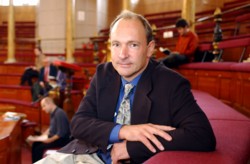
Tim Berners-Lee graduated from the Queen's College at Oxford University, England, 1976. Whilst there he built his first computer with a soldering iron, TTL gates, an M6800 processor and an old television.
He spent two years with Plessey Telecommunications Ltd (Poole, Dorset, UK) a major UK Telecom equipment manufacturer, working on distributed transaction systems, message relays, and bar code technology.
In 1978 Tim left Plessey to join D.G Nash Ltd (Ferndown, Dorset, UK), where he wrote among other things typesetting software for intelligent printers, and a multitasking operating system.
A year and a half spent as an independent consultant included a six month stint (Jun-Dec 1980)as consultant software engineer at CERN, the European Particle Physics Laboratory in Geneva, Switzerland. Whilst there, he wrote for his own private use his first program for storing information including using random associations. Named "Enquire", and never published, this program formed the conceptual basis for the future development of the World Wide Web.
From 1981 until 1984, Tim worked at John Poole's Image Computer Systems Ltd, with technical design responsibility. Work here included real time control firmware, graphics and communications software, and a generic macro language. In 1984, he took up a fellowship at CERN, to work on distributed real-time systems for scientific data acquisition and system control. Among other things, he worked on FASTBUS system software and designed a heterogeneous remote procedure call system.
In 1989, he proposed a global hypertext project, to be known as the World Wide Web. Based on the earlier "Enquire" work, it was designed to allow people to work together by combining their knowledge in a web of hypertext documents. He wrote the first World Wide Web server, "httpd", and the first client, "WorldWideWeb" a what-you-see-is-what-you-get hypertext browser/editor which ran in the NeXTStep environment. This work was started in October 1990, and the program "WorldWideWeb" first made available within CERN in December, and on the Internet at large in the summer of 1991.
Through 1991 and 1993, Tim continued working on the design of the Web, coordinating feedback from users across the Internet. His initial specifications of URIs, HTTP and HTML were refined and discussed in larger circles as the Web technology spread.
In 1994, Tim founded the World Wide Web Consortium at the Laboratory for Computer Science (LCS) at the Massachusetts Institute of Technology (MIT). Since that time he has served as the Director of the World Wide Web Consortium which coordinates Web development worldwide, with teams at MIT, at INRIA in France, and at Keio University in Japan. The Consortium takes as its goal to lead the Web to its full potential, ensuring its stability through rapid evolution and revolutionary transformations of its usage. The Consortium may be found at http://www.w3.org/.
In 1999, he became the first holder of the 3Com Founders chair at LCS, and is now a Senior Research Scientist within the Lab. The Lab merged with the AI lab to became "CSAIL", the Computer Science and Artificail Intelligence Laboratory at MIT.
Chronology
1976 A Physics graduate of The Queen's College, Oxford University, England.
Principal engineer with PlesseyTelecommunications in PooleFounding,
1980 First hypertext system called "Enquire"
1981-1984 director of ImageComputer Systems
1989 Started at CERN, Geneva Switzerland and writes his "www proposal"
1990 Inventes World Wide Web server and client software for NeXTStep.
1995 he received a "Kilby Young Innovator" award by the THE KILBY AWARDS FOUNDATION and was a corecipient of the ACM Software Systems Award.
July, 1996 he was awarded a Distinguished Fellowship of the British Computer Society
Currently he is the Director of the W3Consortium and also a Principal Research Scientist at the Massachusetts Institute of Technology Laboratory for Computer Science (MIT LCS).
Honors and awards
1995
The Interactive Art Jury awarded him an Honorary Golden Nica in the category Interactive Art, which is the biggest rize to be won for computer art.
received a "Kilby Young Innovator" award by the THE KILBY AWARDS FOUNDATION
co-recipient of the ACM Software Systems Award.
In 1995, Tim Berners-Lee received the Kilby Foundation's "Young Innovator of the Year" Award, and an honorary Prix Ars Electronica, and was corecipient of the ACM Software Systems Award.
1996 July,
honorary degree from the Parsons School of Design, New York (D.F.A., 1996) ,
honorary degree from Southampton University (D.Sc., 1996),
awarded a Distinguished Fellowship of the British Computer Society
honorary degree from Southampton University (D.Sc., 1996),
awarded a Distinguished Fellowship of the British Computer Society
1997
he was awarded the IEEE Koji Kobayashi Computers and Communications Award, the Duddell Medal of the Institute of Physics, the Interactive Services Association's Distinguished Service Award, the MCI Computerworld/Smithsonian Award for Leadership in Innovation, The International Communication Institute's Columbus Prize, and an OBE.
1998
he received the Charles Babbage award, the Mountbatten Medal of the National Electronics Council, the Lord Lloyd of Kilgerran Prize from the Foundation for Science and Technology, PC Magazine Lifetime Achievement Award in Technical Excellence, a MacArthur Fellowship and The Eduard Rhein technology award.
honorary degree from Essex University (D.U.)
honorary degree from Southern Cross University (1998),
1999
, Time magazine dubbed him one of the 100 greatest minds of the century and he received a World Technology Award for Communication Technology, and an Honorary Fellowship to the Society for Technical Communications.
2000
Received the Paul Evan Peters Award of ARL, Educause and CNI, the Electronic Freedom Foundation's pioneer award, and the George R Stibitz Computer Pioneer award at the American Computer Museum, and the Special Award for Outstanding Contribution of the World Television Forum.
honorary degree from the Open University (D.U., 2000),
2001
Received the Sir Frank Whittle Medal from the Royal Academy of Engineering.
honorary degree from Columbia University (D.Law),
honorary degree from Oxford University
honorary degree from The University of Port Elizabeth (DSc).
Distinguished Fellow of the British Computer Society,
Honorary Fellow of the Institution of Electrical Engineers.,
Mmember of the American Academy of Arts and Sciences,
Fellow of the Royal Society.
honorary degree from Oxford University
honorary degree from The University of Port Elizabeth (DSc).
Distinguished Fellow of the British Computer Society,
Honorary Fellow of the Institution of Electrical Engineers.,
Mmember of the American Academy of Arts and Sciences,
Fellow of the Royal Society.
2002
Was the recipient of the Japan Prize from the Science and Technology Foundation of Japan
.He shared the Prince of Asturias Foundadtion Prize for Scientific and Technical Research with with Larry Roberts, Rob Kahn and Vint Cerf; became a Fellow of the Guglielmo Marconi Foundation,
and recieved the Albert Medal of the Royal Society for the encouragement of Art, Manufactures and Commerce (RSA).
.He shared the Prince of Asturias Foundadtion Prize for Scientific and Technical Research with with Larry Roberts, Rob Kahn and Vint Cerf; became a Fellow of the Guglielmo Marconi Foundation,
and recieved the Albert Medal of the Royal Society for the encouragement of Art, Manufactures and Commerce (RSA).
2004 April 14,
Millennium Technology Prize; Finish Technology Award Foundation worth 1 million dollar
Knighthood of the British Empire (KBE) for services to the global development of the Internet.
MARK DEAN
 | Dr. Mark Dean IBM Fellow Vice President, Almaden Research Center Senior Location Executive-Silicon Valley |
Dr. Mark E. Dean is an IBM Fellow, vice president of the IBM Almaden Research Center in San Jose, California, and Senior Location Executive in Silicon Valley. He oversees more than 400 scientists and engineers doing exploratory and applied research in various hardware, software and services areas, including nanotechnology, materials science, storage systems, data management, web technologies, workplace practices and user interfaces. An engineer by training, Dr. Dean has more than 25 years experience in the IT industry -- all with IBM -- where he has been central to the design of a wide range of IBM computers.
Dr. Dean has held various positions in several different cities and IBM divisions. Prior to assuming leadership of the Almaden lab in 2004, Dr. Dean was vice president for hardware and systems architecture in IBM's Systems and Technology Group (STG) in Tucson, Arizona. While there, he significantly enhanced STG's hardware and systems strategy and architectures to support continued market share growth and industry leadership in IBM's server and storage systems business. Before STG, Dr. Dean was a vice president in IBM's Storage Technology Group, focused on the company's storage systems strategy and technology roadmap.
Prior to his time in Tucson, Dr. Dean was the vice president for Systems Research at IBM's Watson Research Center in Yorktown Heights, New York, where he was responsible for the research and application of systems technologies spanning circuits to operating environments. Key technologies from his research team include petaflop supercomputer systems structures (BlueGene), digital visualization, design automation tools, Linux optimizations for servers and embedded systems, algorithms for computational science, memory compression, S/390 & PowerPC processors, embedded systems research, formal verification methods and high-speed low-power circuits.
In 1997, Dean was named to be both director of the Austin Research Laboratory and director of Advanced Technology Development for the IBM Enterprise Server Group. Achievements there included testing of the first gigahertz CMOS microprocessor, design of a high-speed DRAM and development of the "cellular" server architecture, which is optimized for managing, storing, searching, distributing and mining complex data (such as video, audio and high-resolution images).
Before this, Dr. Dean held several engineering positions at IBM in the area of computer system hardware architecture and design in Boca Raton, Florida, and Austin. He has developed all types of computer systems, from embedded systems to supercomputers. He was also chief engineer for the development of the IBM PC/AT, ISA systems bus, PS/2 Model 70 & 80, the Color Graphics Adapter in the original IBM PC and numerous other subsystems. One invention -- the Industry Standard Architecture (ISA) "bus," which permitted add-on devices like the keyboard, disk drives and printers to be connected to the motherboard -- would earn election to the National Inventors Hall of Fame for Dean and colleague Dennis Moeller.
Dr. Dean received a BSEE degree from the University of Tennessee in 1979, an MSEE degree from Florida Atlantic University in 1982, and a Ph.D. in Electrical Engineering from Stanford University in 1992. He has papers published in the IEEE Computer Society Press, MIT Press, and IBM Research Journal.
Dr. Dean's most recent awards include: member of the American Academy of Arts and Science and National Academy of Engineering, IEEE Fellow, the CCG Black Engineer of the Year Award, the NSBE Distinguished Engineer award, the University of Tennessee COE Dougherty Award, induction into the National Inventor's Hall of Fame, and recipient of the Ronald H. Brown American Innovators Award. Dr. Dean was appointed to IBM Fellow in 1995, IBM's highest technical honor. He is a member of the IBM Academy of Technology. He has received several academic and IBM awards, including thirteen Invention Achievement Awards and six Corporate Awards. Dr. Dean has more than 40 patents or patents pending.
DOUGLAS ENGELBART
Douglas Engelbart has always been ahead of his time, having idea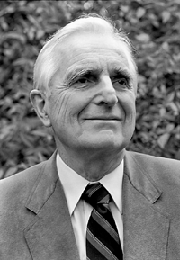 s that seemed far-fetched at the time but later were taken for granted. For instance, as far back as the 1960s he was touting the use of computers for online conferencing and collaboration. Engelbart's most famous invention is the computer mouse, also developed in the 1960s, but not used commercially until the 1980s. Like Vannevar Bush and J.C.R. Licklider, Engelbart wanted to use technology to augment human intellect. He saw technology, especially computers, as the answers to the problem of dealing with the ever more complex modern world and has dedicated his life to the pursuit of developing technology to augment human intellect.
s that seemed far-fetched at the time but later were taken for granted. For instance, as far back as the 1960s he was touting the use of computers for online conferencing and collaboration. Engelbart's most famous invention is the computer mouse, also developed in the 1960s, but not used commercially until the 1980s. Like Vannevar Bush and J.C.R. Licklider, Engelbart wanted to use technology to augment human intellect. He saw technology, especially computers, as the answers to the problem of dealing with the ever more complex modern world and has dedicated his life to the pursuit of developing technology to augment human intellect. Early Years
Douglas Engelbart was born in 1925, in Oregon, where he grew up on a small farm. In 1942, he graduated high school and went to Oregon State University to study electrical engineering. His studies were interrupted by WWII. He joined the Navy and spent two years in the Philippines as a radar technician. While stationed in the Philippines he read Vannevar Bush's "As We may Think." Engelbart would later write to Bush acknowledging the influence Bush's article had had on his own work. (Zachary, 267).
Engelbart's Vision
Engelbart went back to school after the war and received his degree in 1948. He then went to work for the NACA Ames Laboratory—the pre-cursor to NASA. By 1950, Engelbart began to grow restless. "I realized that I didn't have any more goals than a steady job, getting married and living happily ever after," and he asked himself, "How can my career maximize my contribution to mankind?" (Engelbart in O'Brien) He thought about how the world was growing ever more complex and remembered his experience reading Bush. He began to "envision people sitting in front of displays, 'flying around' in an information space where they could formulate and organize their ideas with incredible speed and flexibility." (Engelbart bio, Bootstrap Institute). This was, of course, well before the Internet or World Wide Web came into existence.
With his new goal in mind, Engelbart enrolled in the graduate program in electrical engineering at UC Berkeley and earned his Ph.D. in 1955. He stayed at Berkeley as an Assistant Professor, but soon he realized that his dreams of using computers to augment human intellect were to far ahead of the mainstream to be pursued in that setting. Engelbart left Berkeley and got a research position at the Stanford Research Institute (SRI)
At SRI, Engelbart formulated a new discipline aimed helping organizations keep up with the growing complexity and urgency they were facing with the exponential growth and development of technology, or as he simply put it, augmenting human intellect. In 1962, he wrote his seminal work, Augmenting Human Intellect: A Conceptual Framework . This paper set out the basic ideas that have continued to guide Engelbart's work:
"By 'augmenting human intellect' we mean increasing the capability of a man to approach a complex problem situation, to gain comprehension to suit his particular needs, and to derive solutions to problems. Increased capability in this respect is taken to mean a mixture of the following: more-rapid comprehension, better comprehension, the possibility of gaining a useful degree of comprehension in a situation that previously was too complex, speedier solutions, better solutions, and the possibility of finding solutions to problems that before seemed insoluble. And by "complex situations" we include the professional problems of diplomats, executives, social scientists, life scientists, physical scientists, attorneys, designers—whether the problem situation exists for twenty minutes or twenty years. We do not speak of isolated clever tricks that help in particular situations. We refer to a way of life in an integrated domain where hunches, cut-and-try, intangibles, and the human "feel for a situation" usefully co-exist with powerful concepts, streamlined terminology and notation, sophisticated methods, and high-powered electronic aids." (Engelbart, Augmenting Human Intellect: Introduction)
NLS
In 1963, Engelbart set up his own research lab. He called it the Augmentation Research Center. Throughout the 1960s and 1970s his mlab developed an elaborate hypermedia—groupware system called NLS (oNLine System). NLS facilitated the creation of digital libraries and storage and retrieval of electronic documents using hypertext. This was the first successful implementation of hypertext. NLS used a new 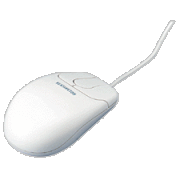 device to facilitate computer interaction—the mouse. (The mouse was not adopted for general use until the 1980s when Apple computers began using them). NLS also created new graphical user interfaces implementing a windowing environment and allowed the user to e-mail other users as well as offering a variety of word processing options. Perhaps most remarkably, NLS also provided for on-screen video teleconferencing. All of these technologies, which are now ubiquitous, were truly astonishing to most back in the 1960s.
device to facilitate computer interaction—the mouse. (The mouse was not adopted for general use until the 1980s when Apple computers began using them). NLS also created new graphical user interfaces implementing a windowing environment and allowed the user to e-mail other users as well as offering a variety of word processing options. Perhaps most remarkably, NLS also provided for on-screen video teleconferencing. All of these technologies, which are now ubiquitous, were truly astonishing to most back in the 1960s. In 1968, at the Fall Joint Computer Conference in San Francisco, Engelbart demonstrated NLS in a 90 minute multimedia presentation that included a live video conference with staff members back in his lab 30 miles away. To this day, Engelbart's demo is still known as "the mother of all demos." It was truly groundbreaking, but Engelbart was way ahead of his time. His ideas were to different and new for others to fully grasp. Paul Saffo of the Institute for the Future said," "It [the demo] was like a UFO landing on the White House lawn." (Saffo in O'Brien). Some people in attendance thought the whole thing was a hoax.
ARPA
Engelbart had developed NLS with ARPA funding. He was excited about the new network ARPA was building. He saw it as a vehicle to extend NLS and increase distributed collaboration. "I realized there was a ready-made computer community," said Engelbart. "It was just the thing I was looking for." (Engelbart in Hafner & Lyon, 78). SRI, where Engelbart's lab was became the second node on the ARPANET.
Engelbart was very involved in the whole project and put together the Network information Center (NIC) which used NLS as a sort of online 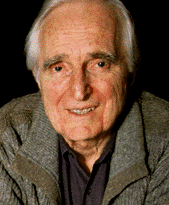 clearinghouse for ARPANET resources. Larry Roberts, the principal architect of the ARAPANET, later recalled, " Engelbart at SRI had a hypertext system that he was using at SRI and we all used it. We arranged with him to be the document center for the network so all of the documentation, all of the publications would be online at SRI." (Roberts in Segaller, 127).
clearinghouse for ARPANET resources. Larry Roberts, the principal architect of the ARAPANET, later recalled, " Engelbart at SRI had a hypertext system that he was using at SRI and we all used it. We arranged with him to be the document center for the network so all of the documentation, all of the publications would be online at SRI." (Roberts in Segaller, 127). Engelbart has continued to work on augmenting human intellect, seldom receiving the acknowledgement many believe he deserves. In 1989, he founded the Bootstrap Institute to foster high performance organizations by developing enabling technologies and promoting collaboration. At age 75, his work continues.

LINUS TORVALDS
In 1991 Linus Torvalds, a 21-year-old computer science student at the University of Helsinki, Fin., having just purchased his first personal computer (PC), decided that he was not satisfied with the computer's operating system (OS). His PC used MS-DOS (the disk operating system from Microsoft Corp.), but Torvalds preferred the UNIX operating system he had used on the university's computers. He decided to create his own PC-based version of UNIX. Months of determined programming work yielded the beginnings of an operating system known as Linux that, eight years later, developed into what many observers saw as a genuine threat to mighty Microsoft and its seemingly ubiquitous Windows OS. By 1999 Torvalds becomes a cult hero to a devoted band of computer users.
Torvalds was born in 1969 and grew up in Helsinki, father Nils Torvalds(eds.). At the age of 10 he began to dabble in computer programming on his grandfather's Commodore VIC-20. By the time he reached college, Torvalds considered himself an accomplished enough programmer to take on the Herculean task of creating an alternate operating system for his new PC. Once he had completed a rough version of Linux, he posted a message on the Internet to alert other PC users to his new system. He made the software available for free downloading, and, as was a common practice among software developers at the time, he released the source code, which meant that anyone with knowledge of computer programming could modify Linux to suit their own purposes. Linux soon had a following of enthusiastic supporters who, because they had access to the source code, were able to help Torvalds retool and refine the software.
Torvalds said he had no qualms with Gates's or Microsoft's financial success--he simply detested poorly engineered software. By 1999 an estimated seven million computers were running on Linux, still available free of charge, and many major software companies had announced plans to support it. Meanwhile, Torvalds had taken a position with Transmeta Corp., owned by Microsoft cofounder Paul Allen, working on a top-secret project that many in the high-tech community assumed would involve some future assault on the Microsoft empire.(1)
Chronology
1969
Born in Helsinki, Finland.
1983
Richard Stallman created the Free Software Foundation (GNU project).
1986
Design of the Unix Operating System by Marice J. Bach was published. Minix period (1988-1991)
1988.
Admitted to the University . The same year Minix emerged.
1990
Takes his first C programming class.
1991
The start of infamous Novell vs U.C. Berkeley lawsuit
The beginning of Linux development (1991-1992)
Hermit-like work during early kernel releases
The beginning of Linux development (1991-1992)
Hermit-like work during early kernel releases
september; Using Marice J Bach book Design of the Unix Operating System and Minix released the first (0.01) version of Linux kernel (at the age of 22).
October; Announced the first "official" version of Linux, which was version 0.02. At that point, Linux was able to run bash (the GNU Bourne Again Shell) and GCC (the GNU C compiler), but not much else.
1992.
January; More or less stable version 0.12 released. License was changed to GPL. Due to stability this version was soon renamed to 0.9
March; Linux v .95 was released.
June; 386BSD 0.1 was released. A CD-ROM version of 386BSD has been announced in Dr. Dobb's Journal. All of the distributions and compilation files would fit onto 180Meg of hard drive.
Yggdrasil released the first CD-ROM distribution. "Linux wave" started
Web began Internet commercialization wave
Successful Fight with FreeBSD (1993-1997)
Web began Internet commercialization wave
Successful Fight with FreeBSD (1993-1997)
1993
December; 386BSD 1.0 was released on CD ROM
FreeBSD 1.0 was released. FreeBSD, which originally started life as 386bsd 0.1 with the patch kit applied, has since evolved into an entirely separate BSD lineage in its own right and incorporates many important innovations.
FreeBSD 1.0 was released. FreeBSD, which originally started life as 386bsd 0.1 with the patch kit applied, has since evolved into an entirely separate BSD lineage in its own right and incorporates many important innovations.
1994
Version 0.99pl15 aka v.1.0 was released via Internet. WEB revolution started with Linux as one of the major beneficiaries. At least five CD Rom distributors already exist selling ~50,000 CD ROM a month. In October Caldera was founded by Bryan Sparks as a start-up venture funded by Ray Noorda, former CEO of Novell. Still very weak networking support limited its role as a workstation.
1994
May; A very successful FreeBSD 1.1 was released.
Novell and U.C. Berkeley settled their long-running lawsuit over the legal status of the Berkeley Net/2 tape
Digital invested money into two porting projects to bring Linux to DEC Alpha. Professionals from DEC started contributing to Linux. Quality of the kernel improved, a pretty decent Ext2 filesystem was added. Networking started to look acceptable.
Novell and U.C. Berkeley settled their long-running lawsuit over the legal status of the Berkeley Net/2 tape
Digital invested money into two porting projects to bring Linux to DEC Alpha. Professionals from DEC started contributing to Linux. Quality of the kernel improved, a pretty decent Ext2 filesystem was added. Networking started to look acceptable.
1995
January FreeBSD 2.0 was released.
1995
Red Hat merged with ACC -- Robert Yong of ACC (former founder of Linux Journal) became a CEO.
1996
Linus' first daughter was born. Minor disruptions of kernel development.
August; FreeBSD 2.1.5 released
December Linux 2.0 was released
1997
Linux meets Microsoft: end of the Finland period and of the academic career (1988-1997 -- he spent 10 years as a student and researcher at the University of Helsinki, coordinating development of the kernel since 1992). Now he decided to become rich and moved to the Bay Area (Santa Clara) to work for Transmeta (Microsoft's Paul Allen is one of major investors).
Honors and awards
1997 Linus Torvalds Receives 1997 Nokia Foundation Award
March 1997 Linus Torvalds receives Lifetime Achievement Award at Uniforum 

No comments:
Post a Comment